Wednesday, April 9, 2014
Personal Philosophy
With the barrage of tweets, Facebook posts, and various social media posts that occur in your feeds every day, it is hard to imagine a time when you lived without social media. Every moment of life is an opportunity to document and post about, a potential Facebook post or an Instagram photo. However, while social media helps people connect with friends and share their thoughts, it also has created isolation as people would rather use their phones instead of talking face-to-face. As technology becomes increasingly prevalent in everyday life, it is more important, now than ever, to temporarily unplug and live in the moment.
The usage of technology is driven by the desire to document everything, from our rambling musings to funny selfies. This instinct to capture everything on something tangible, like film or a tweet, is deeply ingrained in most of us. As an eighth-grader in Yosemite, I remember when our group leader pointed out a coyote. We all whipped out our cameras and phones and began snapping pictures of the creature. However, one girl merely stood there, observing the coyote. I later asked her why she did not take a picture and she replied, “I wanted to see it through my own eyes, not through a screen”. At the time, I thought she was foolish. How was she supposed to remember the animal if she never took a picture? Now, I understand that our memories will be sharper if we step away from the phone and fully engage in, not just witness, the event. Not everything about our lives needs to be documented. Although social media can be seen as a digital journal, a way to document our lives, it should not become an obsessive habit that prevents us from really absorbing everything in the present. Trying to post everything on social media can cause us to think more about photo filters, witty wording, and gaining likes instead of living in the moment.
In my own life, I have witnessed how social media has both strengthened and hindered social bonds. Though I have reconnected with friends through social media, I have also experienced how technology can be isolating. I know people who are constantly on their phone, playing games and hungrily checking their social media feeds. It is often times difficult to converse to with such humans because they seem to be preoccupied with something more important on their phones. Since I have never sent a text message in my life (yes, never), I cannot personally attest to the differences between texting and actual speaking. However, just like e-mails cannot completely replace hand-written letters; texting people cannot supplant actual conversation. A conversation without sound loses much of the nuances and personality that comes with speaking. By talking to the people who are around you, you connect with them better than if you used social media.
Despite my opinions about the overuse of technology, I do not propose that we all retreat to the Stone Age and communicate through chest-thumping and cave paintings. I also certainly do not advocate that people completely stop checking their social media feeds. After all, one can only resist the lure of Instagram pictures of cute babies or the ping that Twitter makes when a notification pops up for so long. Instead, people should make an effort to disconnect from technology and actively engage with reality more often. Social media does not need to be as isolating as it has become. The next time you see something interesting, suppress that instinctive thought of “quick, take a picture and post it online” and appreciate it with all your attention and senses. Take a few minutes from pining over home interiors on Pinterest to tidy your own room. As Henry David Thoreau once said, “You must live in the present, launch yourself on every wave, find your eternity in each moment”.

Monday, March 31, 2014
Chapters 11-15 (D) *
Though there are many striking quotes in this section of The Grapes Of Wrath, a quote describing the essence of mankind is particularly insightful. Describing humans' ingrained nature to fight for causes, Steinbeck writes:
And this you can know- fear the time when Manself will not suffer and die for a concept, for this one quality is the foundation of Manself, and this one quality is man, distinctive in the universe (151).
While Steinbeck was writing about the struggles of laborers to organize together, his overarching message is about the dangers of a world of complacent people who are unwilling to sacrifice themselves for an idea. Without trailblazers to pave the way for eventual change, society comes to a standstill because progress is a direct result from changes to the status quo. Despite obstacles and difficult sacrifices, the hardwired desire for improvements has fueled people to dedicate themselves to a cause for centuries.
When I read the quote, I found myself agreeing with Steinbeck's argument that people who champion causes are to be celebrated instead of feared by the rest of society. The quote brought to mind people who have dedicated themselves to the advancement of communities. A present-day connection is the plight of Tibetan monks who are trying to overthrow Chinese occupation in Tibet. Some of the monks have self-immolated in order to bring their struggles to international attention. The sacrifices that people make in order to further a cause that they will not directly benefit from is commendable. Though the monks who have killed themselves in protest of the oppressive rule will never see their dream of an independent Tibet fulfilled during their lifetimes, their selfless actions sparks fiery emotions in others, who will feel impassioned to continue the cause.
In The Grapes of Wrath, the need for peoples' sacrifices in order to make changes shows the importance of not only selflessness, but human unity. Steinbeck argues that people cannot champion a cause alone and that having multiple people creates a sense of unity that propels a movement. The laborers that strike against the landowners are bonded together through their mutual fight, and feel less afraid than if they were alone. In addition, the quote foreshadows that an organization of people is going to happen, because there are many parallels between the intercalary chapters and the chapters about the Joads. The migrants' fierce protectiveness of their communities coupled with the poor treatment of laborers in California may be catalysts that will trigger a creation of a labor union.
When I read the quote, I found myself agreeing with Steinbeck's argument that people who champion causes are to be celebrated instead of feared by the rest of society. The quote brought to mind people who have dedicated themselves to the advancement of communities. A present-day connection is the plight of Tibetan monks who are trying to overthrow Chinese occupation in Tibet. Some of the monks have self-immolated in order to bring their struggles to international attention. The sacrifices that people make in order to further a cause that they will not directly benefit from is commendable. Though the monks who have killed themselves in protest of the oppressive rule will never see their dream of an independent Tibet fulfilled during their lifetimes, their selfless actions sparks fiery emotions in others, who will feel impassioned to continue the cause.
In The Grapes of Wrath, the need for peoples' sacrifices in order to make changes shows the importance of not only selflessness, but human unity. Steinbeck argues that people cannot champion a cause alone and that having multiple people creates a sense of unity that propels a movement. The laborers that strike against the landowners are bonded together through their mutual fight, and feel less afraid than if they were alone. In addition, the quote foreshadows that an organization of people is going to happen, because there are many parallels between the intercalary chapters and the chapters about the Joads. The migrants' fierce protectiveness of their communities coupled with the poor treatment of laborers in California may be catalysts that will trigger a creation of a labor union.
Sunday, March 23, 2014
Chapters 16-19 (B)
Water represents Ma's dignity and self-respect. She laments the lack of water as the cause of the family's dirtiness, which she is ashamed about. The Joads do not wash their potatoes and their clothes, which is a source of anxiety for Ma because she is unused to the filth. In addition, it is part of her maternal duty to keep the household running, which is difficult to do when there is no water for bathing and cleaning. #ch18 #gow
Lying with Granma's corpse reveals Ma's strength and self-sacrifice. She keeps the news of Granma's death away from the Joad family because she wants to keep up morale. Instead, she bottles up her emotions and lays with Granma's body for the entire night. However, this hidden grief takes a toll on Ma, which is shown when Tom puts his hand on her shoulder and she reacts negatively. #ch18 #gow Despite the Joads' own lack of wealth, Ma gives Ivy money when the Wilsons announce their separation from the Joads due to Sairy's sickness. In spite of the hardships that occur while the Joads make their way to CA, Ma retains her generous spirit. Ma is always putting other peoples' needs ahead of her own. The help that she willingly extends to others is ironic, given that Ma and the Joads are extremely self-dependent. #ch18 #gow
Ma takes a skillet and threatens to hit a policeman who disparagingly labels the Joads as "Okies". Ma is fiercely protective of her family. She is also angry that the policeman tries to intimidate her by loosening the gun in his holster. The aggressiveness that he shows towards Ma is unheard of back in Oklahoma. #ch18 #gow
Ma lies to the agricultural inspector because she does not want anyone to know about Granma's death. She rushes the inspection of the Joads' jalopy and tells the inspector that Granma is very sick, when in fact, Granma is dead. This lie is a sacrifice on Ma's part since she cannot confide with the other Joads about Granma. Ma's willingness to lie to government authority reflects her Transcendental beliefs. #ch18 #gow
Thursday, March 20, 2014
Chapters 16-19 (H) *
The circular lives of the migrants serves to highlight the idea that a sense of community is integral for the migrants to continue with their journeys. The repetition in the peoples' lives causes them to fall into patterns of isolation during the day and bonding time at nighttime. The routine of traveling by day and camping with other migrants at night shows how the migrants are trying to instill a sense of familiarity in the midst of confusion about their futures. The migrant camps are breeding grounds for community where the migrants confide with each other about their struggles and their goal of finding work in California. Even though the voyage is full of obstacles, migrants are able to persevere in part because of unity that they create with each other through sharing the same struggle and dream. Steinbeck stresses the importance of family and friends in chapter 17, but in this section, the Joads lose the Wilsons, Noah, and Grandma. The disintegration of the Joad family juxtaposed withe the tight-knit migrant camp communities demonstrates that the Joads may not be able to keep their morale up because close bonds with other people is needed to mitigate the hardships of the trip. Without the bonds with other migrant families, the Joads will feel alone and unable to seek help and advice from others.
A quote that shows the closeness of the families is "And the worlds were built in the evening. The people, moving in from the highways, made them with their tents and their hearts and their brains"(195). The families transition from the sedentary life in their jalopies to migrant camps in the evening. The camps makes them able to meet and connect with others who face the same plight. The bonds created by interactions, however temporary, give people the chance to have a community at a time when everyone is fearful for the future. Like an organized neighborhoods, the migrant camps are run with unofficial regulations. "And the laws, the punishments- and there were only two- a quick and murderous fight or ostracism; and ostracism was the worst"(194). Being outcasted from the group is considered the worst punishment because the offenders will lose the sense of unity that comes with being part of a community. In addition, the offenders will never be able to find a group since their reputations will be known in migrant circles.
A quote that shows the closeness of the families is "And the worlds were built in the evening. The people, moving in from the highways, made them with their tents and their hearts and their brains"(195). The families transition from the sedentary life in their jalopies to migrant camps in the evening. The camps makes them able to meet and connect with others who face the same plight. The bonds created by interactions, however temporary, give people the chance to have a community at a time when everyone is fearful for the future. Like an organized neighborhoods, the migrant camps are run with unofficial regulations. "And the laws, the punishments- and there were only two- a quick and murderous fight or ostracism; and ostracism was the worst"(194). Being outcasted from the group is considered the worst punishment because the offenders will lose the sense of unity that comes with being part of a community. In addition, the offenders will never be able to find a group since their reputations will be known in migrant circles.
Tuesday, March 11, 2014
Chapters 11-15 (C)
Dear Diary,
Today at the store, a migrant and his two boys came in to buy some bread. I told him that we can't sell bread because we need to use it to make sandwiches. He was too poor to buy the whole loaf for fifteen cents, so Al told me to give the loaf to them for free. Imagine my surprise when the man refused the offer and insisted on paying for ten cents worth of bread! His self-reliance stood out to me as a testament to the determination of migrants to retain their autonomy, despite the hardships of moving to an unknown land. This encounter made me cast doubt on the truck drivers' rumors that migrants are thieves. I decided to sell him the entire loaf for ten cents and discounted some peppermint candy for his sons. The shocked and happy expressions on the children's faces made me feel all warm and cozy inside. I now realize that going out of our ways to help and provide for the less-fortunate is important in order to foster a sense of unity in our community. My experience today ties into a story I heard about a wealthy Cadillac-driver who recklessly crashed into a migrant family's jalopy, killing a kid. When the well-off exploit the poor and treat them as lesser beings, then people are divided into groups instead of coming together. When people are in opposition, then humans become obstacles to each other rather than resources. This fracturing of the community is detrimental if people are to improve their lives because cooperation with each other can create change. For example, after the migrant family left, some hunky truck drivers left two half-dollars as a tip! The kind karma that I received because of my charitable act altered my treatment of migrants for the better.
Mae
Friday, March 7, 2014
Chapters 1-10 (D)
In the 1930s, the number of cars being produced in America plummeted from 5.3 million units in 1929 to 2.4 million in 1930. From 1929 to 1932, sales of new automobiles fell by 75 percent and in 1932, automobile companies had a combined loss of $191 million. The drop in car ownership can be attributed to the high prices of cars and gasoline. In addition, the market for luxury cars disappeared and the market for lower-priced cars doubled from 1932 to 1933. Consequently, half of all automobile companies closed. Despite the glum outlook for automobile companies, Ford enjoyed enormous success with its Model A car. In the first two weeks of production, the cars were sold out. 1,261,053 Model A cars were sold in 1930.
Picture of a restored Ford Model A:
 source: Ford Model A Automobile
Prior to the Great Depression, GM and Ford each had control of a third of the car market and smaller companies shared the final third. GM did particularly well in the Great Depression by catering to poorer consumers by axing many of its luxury car brands and shifting its attention to Chevrolet, its high-volume, low-priced car. GM also incentivized people to buy Chevrolet cars by offering financing at a time when banks were not loaning much money. During the Great Depression, Ford, General Motors, and Chrysler became the dominant automobile companies. In 1939, the "Big Three" accounted for 90% of U.S. automobile production. Hudson, Nash, Packard, Studebaker, and Willys-Overland comprised of most of the last 10% share. These companies mostly produced luxury and mid-priced cars, which caused a steep decline in sales as the demand for expensive cars. From only an 8% market share before the Great Depression, Chrysler became a powerful player because of its high production rate, which was about 90 cars per hour. In addition, Chrysler’s Airflow design, famed for its aerodynamic efficiency, became an industry standard.
Picture of a restored Chrysler Airflow:
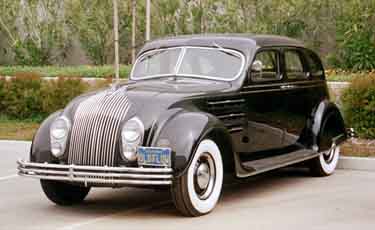 source: Chrysler Airflow (1934)
Picture of a restored Ford Model A:
source: Ford Model A AutomobilePrior to the Great Depression, GM and Ford each had control of a third of the car market and smaller companies shared the final third. GM did particularly well in the Great Depression by catering to poorer consumers by axing many of its luxury car brands and shifting its attention to Chevrolet, its high-volume, low-priced car. GM also incentivized people to buy Chevrolet cars by offering financing at a time when banks were not loaning much money. During the Great Depression, Ford, General Motors, and Chrysler became the dominant automobile companies. In 1939, the "Big Three" accounted for 90% of U.S. automobile production. Hudson, Nash, Packard, Studebaker, and Willys-Overland comprised of most of the last 10% share. These companies mostly produced luxury and mid-priced cars, which caused a steep decline in sales as the demand for expensive cars. From only an 8% market share before the Great Depression, Chrysler became a powerful player because of its high production rate, which was about 90 cars per hour. In addition, Chrysler’s Airflow design, famed for its aerodynamic efficiency, became an industry standard.
Picture of a restored Chrysler Airflow:
source: Chrysler Airflow (1934)Thursday, March 6, 2014
Chapters 1-10 (H)
When addressing the brain-washing that the bank has done to a tractor driver, Steinbeck uses repeated diction, specifically the words "goggled" and "muzzled", in order to illustrate his point that the people who work for greedy corporations are blind to the suffering that they cause and are unable to speak up against the unethical practices that they are forced to do. Steinbeck writes:
A twitch at the controls could swerve the car', but the driver's hands could not twitch because the monster that had built the tractor, the monster that sent the tractor out, had somehow got into the driver's hands, into his brain and muscle, had goggled him and muzzled him—goggled his mind, muzzled his speech, goggled his perception, muzzled his protest (35).Anaphora is used in this passage in order to emphasize the bank's ferocity because the bank uses people as an instrument to exploit the land for financial profit, and changes people to become callous and uncaring about nature or their farming community. Repetition of the words "goggled" and "muzzled" shows how that the bank is restricting the senses of tractor driver. As a result, the driver is unable to see how his job is ruining the livelihoods of the tenant farmers because he only cares about the money that he earns by razing down the land. Big business has corrupted the tractor driver because it prevents him from comprehending his betrayal of the community. Instead, the driver is a puppet of corporations, characterized by "monsters", that are earning profit by evicting the tenant farmers and using machinery to work the land. The placing of the repeated words in front of each clause, "goggled...muzzled...goggled...muzzled..." demonstrates the methodical ways that the bank oppresses the driver by restricting his senses and his obligation to speak out against the bank's practices.
Tuesday, March 4, 2014
Chapters 1-10 (G)
One of the major conflicts explored in the novel is man versus machine, as technology begins to take over jobs previously held by humans and changing the way that people interact with nature. Steinbeck is sympathetic to the plight of tenant farmers struggling to compete with the tractors that are taking over their jobs. A scene that shows the struggle between farmers and machines is when a tractor razes down a house as its inhabitants watch, powerless to stop the destruction. Steinbeck writes:
The tractor cut a straight line on, and the air and the ground vibrated with its thunder. The tenant man stared after it, his rifle in his hand. His wife was beside him, and the quiet children behind. And all of them stared after the tractor (39).
This quote reflects the angry sentiments of the tenants who have been replaced by the tractor. The machine is literally leaving the people behind as it continues onwards, which shows that the advance of technology comes at the expense of humans that will be unemployed and forced to leave their farms as a result of cheaper, more efficient ways of farming. The demolition of the house by the machine symbolizes the wrecking of people's lives by technology because machines displaces tenant farmers and their families, who will have to migrate west in search of employment.
Not only does the machines cause the eviction of farmers, the usage of tractors causes the detachment of people from nature. The loss of personal connections to the land enrage the farmers and serves to intensify the conflict between man and machines as the farmers attempt to cling on to their old farming methods. Whereas the farmers take great care of the land, the tractor drivers lose their connection with nature as a result of machinery that has replaced humans. This transformation of tractor drivers from a person to a machine-driven robot is described by:
The usage of technology in order to do what had been done by farmers leads to a mechanical, unthinking way of life as people, such as the tractor driver, become driven by banks and greedy capitalists instead of relying their intuition to determine what is best for the land. The clash between man and the machines will continue in The Grapes of Wrath as the farmers refuse to adapt and accept the modern, fast-paced way of life set by advances in technology. Not only does the machines cause the eviction of farmers, the usage of tractors causes the detachment of people from nature. The loss of personal connections to the land enrage the farmers and serves to intensify the conflict between man and machines as the farmers attempt to cling on to their old farming methods. Whereas the farmers take great care of the land, the tractor drivers lose their connection with nature as a result of machinery that has replaced humans. This transformation of tractor drivers from a person to a machine-driven robot is described by:
A twitch at the controls could swerve the car', but the driver's hands could not twitch because the monster that had built the tractor, the monster that sent the tractor out, had somehow got into the driver's hands, into his brain and muscle, had goggled him and muzzled him—goggled his mind, muzzled his speech, goggled his perception, muzzled his protest (35).

Saturday, March 1, 2014
Chapters 1-10 (C) *
To Oklahoma farmland,
It is thanks to you that we tenant farmers stay in Oklahoma, despite the terrible weather and financial difficulties that have plagued us.
Your harsh droughts and dust storms have made it so hard for us tenant farmers to plant crops. Coupled with the scarcity of water and the scorching sun, the constant dust kills our carefully tended plants. "If the dust only wouldn't fly. If the top would only stay on the soil, it might not be so bad"(32). However, we are hopeful that "...maybe the next year will be a good year"(32). If there are enough wars,"...cotton'll hit the ceiling"(32). If we are lucky and are not evicted by the bank, we may make profits.
The bank's representatives says,"You'll have to get off the land...The bank, the monster owns it. You'll have to go"(34). But these folks don't understand that for generations, our families have raised families and planted crops on you. Signs of our long history as your stewards can be found everywhere, like the"...pump put in ten years ago...the chopping block where a thousand chickens had been killed..."(34). Us farmers have a innate connection to you. We touch the seeds, harvest crops, and eat what we have grown. "That's what makes [this land] ours-being born on it, working it, dying on it. That makes ownership, not a paper with numbers on it"(33).
"Maybe we got to fight to keep our land, like Pa and Grandpa did"(34). It will be an uphill battle all the way, but "we'll get our guns, like Grandpa did when the Indians came"(34). We will not yield you to the bank and the ferocious tractors without a fight. Investing our tiny profits and our livelihood into you brings us dignity and a sense of purpose because"[If a man] owns property only so he can walk on it and handle it and be sad when it isn't doing well and feel fine when the rain falls on it, that property is him, and some ways he's bigger because he owns it"(37). Unlike the bank, we are not here to profit at your expense. As tenant farmers, we want to continue with our simple way of living and our family history by living on you, the place where we grew up. Kickin' us off will take more than a bout of bad weather and the monsterous bank's threats. We are proud to be Oklahomans and will do everything we can in order to stay on you, the glorious farmland that we call home.
With much thanks and gratitude,
The Joad Family
Subscribe to:
Posts (Atom)